Imagine being adopted at birth, not in your home country, but abroad, where the cultural difference is significant, and never feeling like you totally fit in. Imagine also that the search for your birth parents is far from easy and when you do finally make contact it is hardly the warm embrace you anticipated it to be.

That is the starting point for a humorous and poignant look at the issue, inspired by writer and performer Michelle Lim Davidson’s own, real world experiences. Hannah (Lim Davidson) didn’t look like anyone else in her class at school in Sydney. Now a young adult, she has worked freelance in the arts. It was a year ago that she first met her birth mother, Umma (Heather Jeong).
Now Hannah has returned to South Korea, where she was born, to get to know Umma. Hannah speaks only a few words of broken Korean. Even though she has tried learning the language, she has found that difficult. Umma works seven days a week in a mixed retail business and she makes the reunion difficult. She is hardly warm and inviting. Rather, standoffish. Quite acerbic actually … which is where the laughs come in.

And, when Hannah asks, Umma doesn’t want to tell her about her birth father, although clearly he is no longer on the scene. Interestingly, it is K-Pop that results in a thaw in relations between Hannah and Umma. Still, their connection takes time to develop and is far from assured.
In her writer’s notes, Lim Davidson explains that she grew up in a small suburb of Newcastle. For many years, she was the only Asian girl at her primary school, often startled by her own reflection. She expected to see a blonde, blue-eyed beach kid. Instead, she witnessed a dark-haired, brown-eyed girl.

For a long-time, she believed her adoption was an isolated event. When she began searching for her biological family, she came to realise that her story was far from the exception, but one that connects her to thousands of others. Since the 1950s, more than 200,000 Korean children have been sent abroad for adoption, raised across Europe, North American and Australia.
Lim Davidson makes the point that despite being the largest group of inter-country adoptees in Australia, Korean stories have remained largely unexplored. As a writer, she has found a way for Hannah’s tale to readily resonate. In fact, it is a fish out of water story, in which the so-called fish desperately wants to learn how to swim. And, in this case, comedy is the X-factor – the vehicle that can make it happen.

There is an easy-going charm and deliberate awkwardness in how events unfold. Hannah and Umma’s life experiences have been so decidedly different that, at first, it is difficult to find common ground, notwithstanding their blood ties. Lim Davidson and Jeong lean into their roles adroitly. Conflict is the safe space that both navigate with dexterity and purpose, underneath which sit deep seated feelings, which we see more as the play develops. Lim Davidson and Jeong expertly navigate the push-pull relationship between Hannah and Umma.
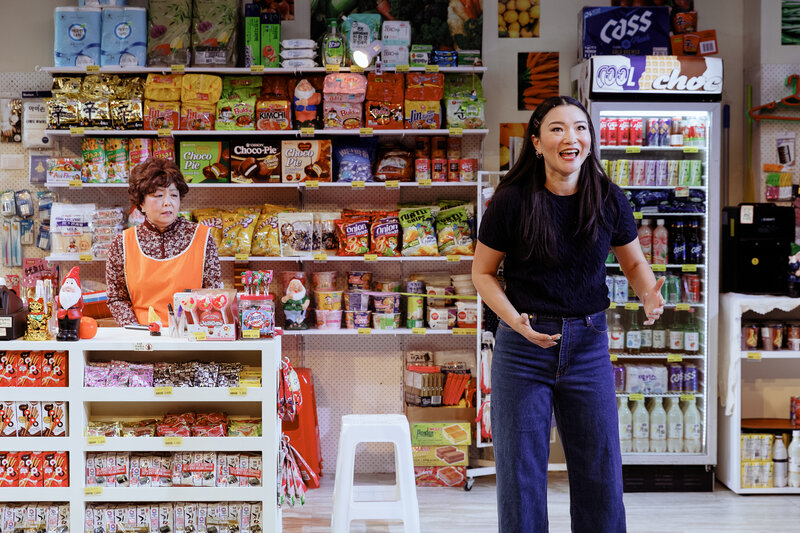
The colourful, appealing shop setting contains not only traditional grocery items, but everything from sunglasses to gnomes. Umma is particularly fond of the latter. The designer is Mel Page. Coupled with attractive lighting by Kate Baldwin and a boisterous score from composer and sound designer Brendon Boney, Koreaboo finds audience connection.

Eighty minutes without interval, Jessica Arthur directs a telling tale, namely a search for identity and belonging, with humanity and heart. Koreaboo is on at Beckett Theatre, at Malthouse Theatre, until 10th October, 2026.
Alex First
Other reviews you might enjoy:
- K-Box (Malthouse Theatre) – theatre review
- Meow Meow’s The Red Shoes at Malthouse Theatre – theatre review
- Macbeth (An Undoing) at Malthouse Theatre – theatre review

Alex First is the editor of The Blurb. Alex is a Melbourne based journalist and communications specialist. He also contributes to The Blurb on film and theatre.