Can artificial intelligence develop from an increasingly valuable tool for business and personal use to a destructive force that will wipe out the human race? Unfortunately, this question appears no longer to be purely in the realm of science fiction. It is increasingly being debated and speculated about.
The doomsdayers are convinced the threat of that happening is real – likely even.

It is hard not to think about these things while watching Tom Holloway’s new world premiere play ELIZA. Inspired by truth and developed through MTC’s NEXT STAGE Writers’ Program, it is a riveting psychological thriller about the birth of AI. In 1950, English mathematician Alan Turing published a paper titled Computer Machinery and Intelligence. It proposed a test of machine intelligence, termed The Imitation Game.
But it was 1966 when Joseph Weizenbaum, a German-American computer scientist, a professor at Massachusetts Institute of Technology, created the first chatbot. Named ELIZA, after Eliza Doolittle in George Bernard Shaw’s play Pygmalion, it was a mock psychotherapist that used natural language processing to converse with humans. As we see in this theatrical offering of the same name, the excitement at the prospect of a machine interacting in a meaningful way with a human was palpable.

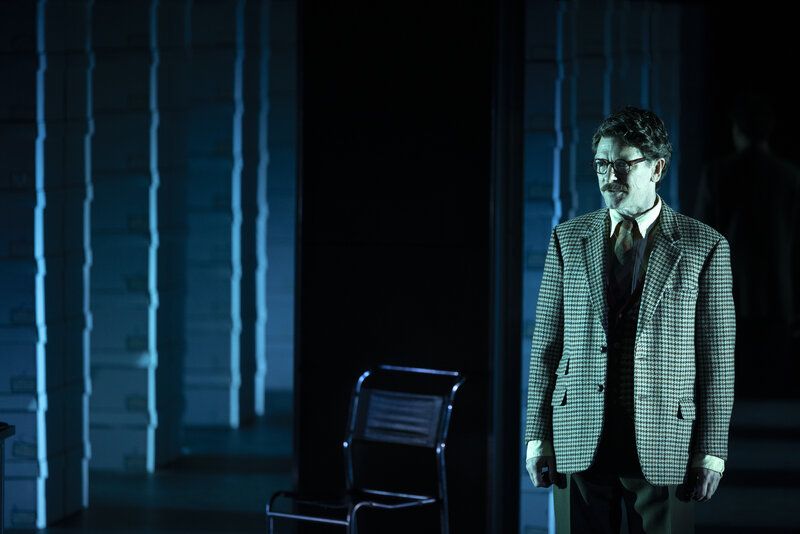
Weizenbaum, masterfully played by Dan Spielman, carried the childhood trauma of fleeing Nazi Germany, after what he witnessed in his home. He was pushed to undertake therapy by empathetic secretary Becky (a delightful performance from Manali Datar). Becky, who had her own issues at home, was herself receiving counselling.
Those deep conversations with a therapist triggered Weizenbaum into thinking that a computer could be programmed to ask the right questions. And so it was that he took Becky along for what became a wild ride, teaching her coding. Indeed, with the prospect of an upgrade in pay, she was a quick learner. Mind you, Becky’s elevation in the pecking order hardly endeared Weizenbaum to his long-serving offsider Ronald (superbly realised by Hamish Michael).

It was when Weizenbaum took liberties with the truth though that his grand concept began to careen off the rails. Becky was outraged and Ronald pleased to get his own back, while Weizenbaum, who was feted, descended into darkness.
ELIZA is such a cleverly conceived and executed production, with three brilliant performances. Put simply, it is thrilling to watch. The excitement starts when you enter the theatre. What confronts you is a step back in time, a set replete with computers still in their infancy and neatly turned-out rows of cardboard boxes in their hundreds. The stage is set both literally and figuratively. Set designer Dale Ferguson has excelled.

There is so much skill in Holloway’s writing – the juxtaposition of the past, the present and the brave new world that could be the future. Spielman is utterly convincing as a troubled intellectual powerhouse. He mixes excitement and enthusiasm with a descent into madness. Datar brings a most attractive freshness, a desire to please, to her role, before pushing back as Becky is blindsided.
Hamish Michael plays several parts with distinction. Apart from Ronald, he is Marvin Minsky, the co-founder of MIT’s AI lab. He is also a journalist, and the recently elected head of the National Institute of Mental Health, the lead federal agency in the US on mental disorders. He does a power of work to clearly differentiate each, adopting different speech patterns, and it pays handsome dividends.

With small movements in the set comes the appearance of two stagehands. They are dressed alike in light blue short-sleeve shirts, striped ties, dark blue trousers and braces, and have a business at all costs approach. It is a very nice touch.
ELIZA, the play, is imbued with humour, fear and anguish. In fact, one of the many strengths of this piece is in the rich tapestry of costuming, most evocative and nostalgic. I was particularly taken by Weizenbaum’s colourful ensemble, notably his waistcoat. All is the work of Matilda Woodroofe.

At one point, I couldn’t exorcise the thought of Alfred Hitchcock’s 1963 thriller The Birds from my mind, which is where AV designer Rhian Hinkley comes to the fore. Coupled with an evocative score from composer and sound designer Kelly Ryall and striking lighting design from Paul Jackson, ELIZA has a strong emotional pull.
One hundred minutes without interval, director Paige Rattray has crafted an extraordinary piece of work that taps into the human psyche. I was left reflecting that we press on as we continue to push the limits, but at what cost? Sixty years after the events depicted in ELIZA, AI has evolved exponentially, with so much more still ahead. The moral and ethical quandaries that brings have been compounded.

ELIZA needs to be seen. It is on at Southbank Theatre, The Sumner until 31st October, 2026.
Alex First
Other reviews you might enjoy:
- Mother Play: a play in five evictions (MTC) – theatre reviews
- The Jungle and the Sea (MTC in collaboration with Lingalayam Dance Company), at Southbank Theatre, The Sumner – theatre review
- A Streetcar Named Desire (MTC) – theatre review

Alex First is the editor of The Blurb. Alex is a Melbourne based journalist and communications specialist. He also contributes to The Blurb on film and theatre.