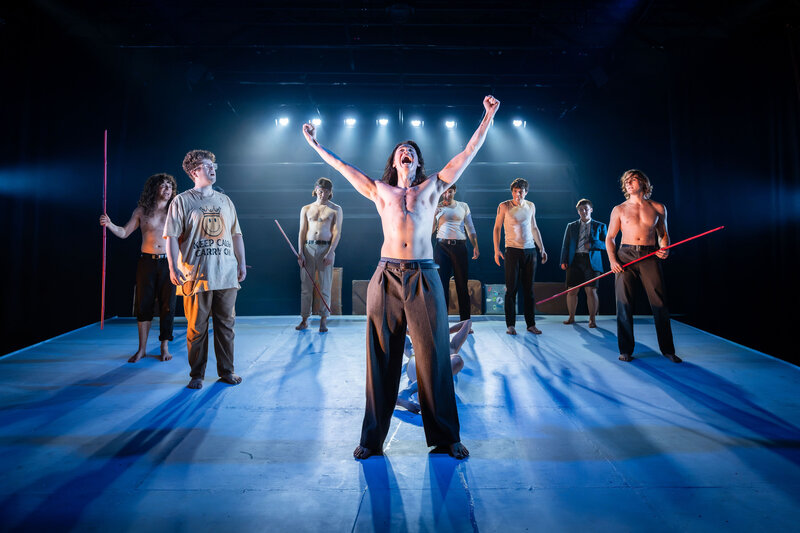
Are men savages? Does the battle for supremacy, for power and control, of man against man know no bounds? Is it in our DNA? The answer to all these questions is a resounding “yes” if Nobel Prize-winning English author William Golding’s iconic work Lord of the Flies is anything to go by.
It was his first novel, published in 1954, while its huge impact as a stage production was first felt in July 1995. That was when the Royal Shakespeare Company at Stratford-upon-Avon professionally produced Nigel Williams’ theatrical dramatisation that he had completed five years earlier.

Now director Steven Mitchell Wright and his excellent cast of 11, along with his expert design team, have taken the blowtorch to it with blindingly positive effect. Unfortunately, deeply reflective of the world today, Wright’s raw, incendiary adaptation crackles, burns and bites. With blood lust pushed to the nth degree, Lord of the Flies still shocks and horrifies, just as it is meant to.
It concerns a group of English boys stuck on an isolated island in a remote region of the Pacific Ocean after their plane crash lands during a wartime evacuation. The lads – in their middle childhood – are the only survivors and try to govern themselves … with disastrous results. Lord of the Flies focuses upon the tension within the group and the alliances that are formed.

As the days go by, the issue of morality comes into sharp focus. Reactions of the marooned youngsters range from the rational and indignant to the irrational, fearful and emotional. The power struggle is that between prattish prefect Jack Merridew (Sean Yuen Halley) and the athletic, charismatic Ralph (Angus Leighton), and their respective followers.
Events turn ugly and then uglier still. Suffice to say, not all will survive. All this plays out in the space of two hours 40 minutes, including interval. I should point out that upon publication in the US, Lord of the Flies wasn’t a great success, selling fewer than 3,000 copies during 1955, before going out of print.

However, it went on to become a best-seller and by the early ‘60s was required reading in many schools. Indeed, in 2005 the book was chosen by TIME magazine as one of the 100 best English novels from 1923 to 2005. It has been adapted to film twice in English, in 1963 by Peter Brook and in 1990 by Harry Hook, as well as once in Filipino (1976). Earlier this year, the BBC released Lord of the Flies as a four-part TV mini-series.
Angus Leighton well channels the changes to Ralph’s easygoing persona as the pressure on him ramps up. Oliver Cowen is strong as the logical, bespectacled, overweight asthmatic Piggy, Ralph’s right-hand man. Sean Yuen Halley brings entitlement, arrogance and contempt to Jack, who is ready, willing and able to ride rough shod over the others.

They and the eight additional members of the cast step up to reveal the essential character traits of a divergent bunch. As we enter the theatre, we witness the testosterone flowing amongst them in a raucous ball game that is underway, setting the scene for what’s to follow.
A stark, angled stage with two tiers of scaffolding at the back provides a broad canvas for events to play out. Evocative costuming and make-up designed by Steven Mitchell Wright and crafted by Hatty Becker help highlight the disintegration of order. Jack Burmeister is at his brilliant best with a searing and dramatic score interspersed with a few lively, popular tunes. His composition is striking. Ben Hughes too is on song with expressive lighting cues that sheet home the turmoil.

So it is that Steven Mitchell Wright helms a masterful and deeply disturbing insight into the human condition. Lord of the Flies continues to resonate long after you leave the theatre. It is on at Theatre Works until 2nd October, 2026.
Alex First
Other reviews you might enjoy:
- Away (Theatre Works) – theatre review
- Ghosts (Theatre Works) – theatre review
- Soldier Boy (Theatre Works) – theatre review

Alex First is the editor of The Blurb. Alex is a Melbourne based journalist and communications specialist. He also contributes to The Blurb on film and theatre.