Anne Frank’s story is a tragic but inspiring one and it is played out in dramatic fashion on stage. As Jews, when her Dutch family was forced to go into hiding during the Holocaust, she was gifted a diary, which she wrote in religiously. It contained her innermost thoughts about those she was with and her views of the world. Her emotions and those of the others holed up with her are laid bare in this Pulitzer and Tony Award-winning play.

They were hidden in an annex above Anne’s father Otto’s business premises by Mr Kraler and Miep Gies. I speak of 13-year-old Anne and her older sister Margot, along with their parents Otto and Edith. Then there was Putti and Petronella Van Daan and their son, Peter, 16 at the time. They were later joined by dentist Jan Dussel.
They went into hiding in Amsterdam on 6th July, 1942 and their secret hide out was raided on 4th August, 1944, following a tip off. It was then that they were deported to concentration camps. Anne died at Bergen-Belsen, allegedly from typhus, in the first quarter of 1945.

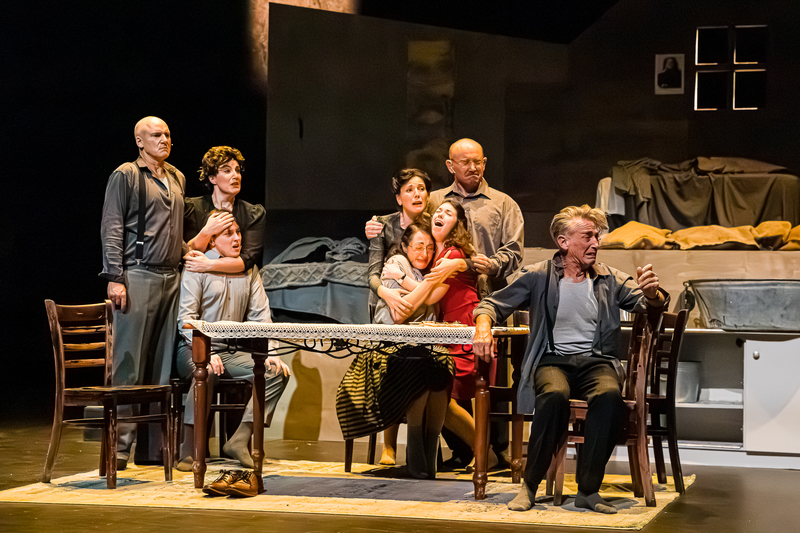
The Diary of Anne Frank lays bare how claustrophobic it would have been to live in close quarters with others, while facing the constant threat of discovery from merciless Nazis. It showcases the build-up of tension and hunger, and an inability to leave a makeshift home for more than two years. The “rules” are these: only speak in whispers between 8am and 6pm, do not to go to the bathroom or turn on a tap for fear of being exposed by workers in the building. Inevitably, there are times when the pressure becomes too much.
The script is by Frances Goodrich and Albert Hackett. It reveals how Anne grows during the horrendous experience. At first, she is seen as an inveterate chatterbox who can and does rub others up the wrong way with her constant “noise”. She says what she thinks, unlike her far more diplomatic, polite and reserved sister.

Anne, who has grand plans of what she will make of her life, is very close to her father, but maintains that her mother doesn’t understand her. During her forced internment, she develops a close bond with Peter, who – is initially – frustrated by her. Otto Frank is painted as the voice of reason. Putti Van Daan, a decade older than his wife, is shown as selfish and angry. He frequently derides her and rides rough shod over Peter. Jan Dussel is used to his space … alone. He finds being confined with Anne challenging, as the pair often don’t see eye to eye.
Based on The Diary of a Young Girl by Anne Frank, published posthumously in 1947, the stage adaptation is moving and insightful. It is headlined by a stellar showing from Chloe-Jean Vincent as Anne and an impressively measured performance by Phil Bedworth as Otto. Vincent’s role calls upon her to push others’ buttons, which she does, while Bedworth is required to “calm the farm”, as metaphorical spot fires explode.

The emotive sounds of outside noise – Nazi jack boots amongst them – are very well captured by audio designer Jordan Gibbs. The lighting design by Jason Bovaird is noteworthy, particularly the way he spotlights diary entries as Anne is reading them. He brings brilliant focus and theatricality to the pointed notations.
Drew Anthony’s production design (he also directs and produces the work) makes much of the small attic-like setting in which the families are thrust together. Annette Stivaletta’s costuming adds authenticity to the production. The stock in trade in The Diary of Anne Frank is fear. Yet, that doesn’t prevent Anne from manifesting positive thoughts, dreaming big and thinking the best of people, despite the Armageddon that envelopes her and Europe.

Two hours plus interval, the play is on at the Athenaeum Theatre until 21st March. It then moves to the State Theatre in Sydney from 25th March to 2nd April, 2026.
Alex First
Other reviews you might enjoy:
- The Father (MTC) – theatre review
- All My Sleep and Waking (Old 505) – theatre review
- Steel Magnolias, at Athenaeum Theatre – theatre review

Alex First is the editor of The Blurb. Alex is a Melbourne based journalist and communications specialist. He also contributes to The Blurb on film and theatre.