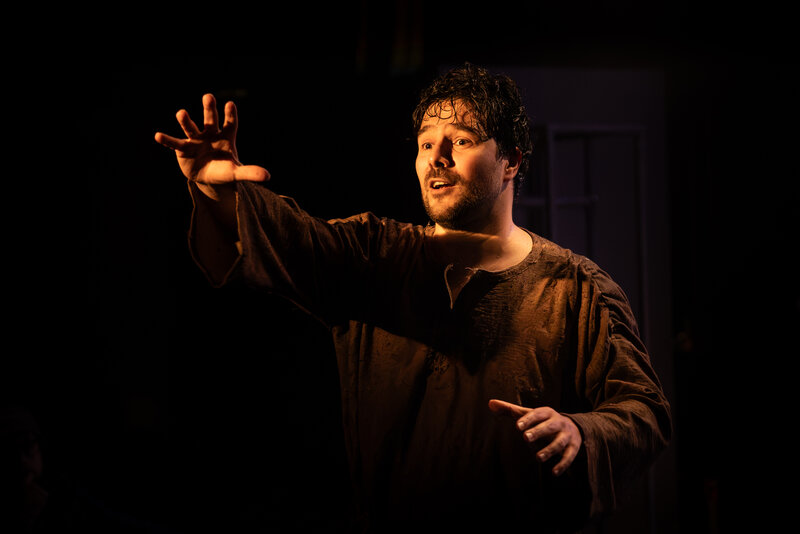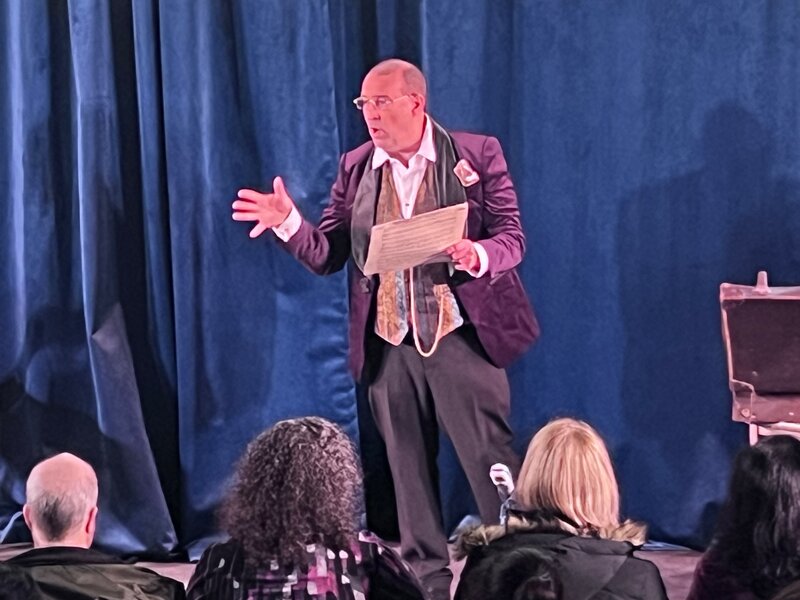
Heinz Lewin, born in Wiesbaden, Germany on 22nd March 1888, was one of the many artists and composers who lives were tragically cut short by the Holocaust. In his case, the 54-year-old Jew perished in the gas chambers at Auschwitz in September 1942. Assuming a German accent and in costume, writer Zeddy Lawrence unravels his life and music with the help of gifted pianist Tomi Kalinski.

Lawrence, who is Lewin’s great grandson, shares stories about Lewin’s heritage, achievements and desperation, as the Nazis invade Europe. With the rise of antisemitism, Lewin fled from Germany to Paris where he was arrested as an enemy alien when the jackboots took control. He was subsequently interned in a labour camp for two years, before being bundled onto a train and transported to his death.

Lewin’s family had originally moved from Russia to Germany, which is where Heinz grew up. The family business – cigarette manufacture – was most successful, but Lewin was not interested in making that his life’s work. His aptitude for music was recognised early. He was a piano prodigy by the age of six and went on to forge a noteworthy career as a feted artist and composer, performing throughout Europe.

He devised music for German and Hollywood movies (think the likes of films starring Gloria Stuart, who went on to play “old” Rose in Titanic) and cut several gramophone records. Of particular import were his operettas and theatre productions. Lewin married Jenni Trabsky, originally from the Ukraine, and the pair had a son named Ralph, but the marriage didn’t last.

Ralph survived the Holocaust by fleeing to Britain. Sadly, Jenni did not. Like Heinz, she too was slaughtered in a death camp. Resplendent with compelling anecdotes, Zeddy has crafted a compelling tale of perseverance and heartbreak. He makes excellent use of video footage and photographs of the era, which pepper Morgen Wieder Lustik, along with the maestro’s music.

Lawrence’s tales about his great grandfather are not delivered in linear fashion. Rather, they jump back and forth in time and in just over an hour, they present a picture of a man who was driven to succeed in a field he truly loved. As for the music he so adroitly composed, it is most attractive and now, 84 years after it was last heard, it resonates anew.

For future performances, go to https://zedwords.au/morgenplay/
Alex First

Alex First is the editor of The Blurb. Alex is a Melbourne based journalist and communications specialist. He also contributes to The Blurb on film and theatre.