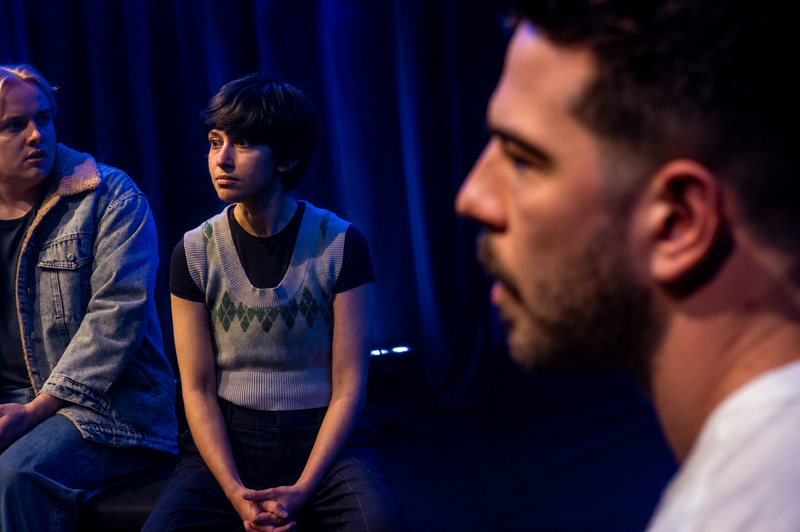
Relationships can be complicated beasts. That is shown up in all its tangled glory (well, not so much glory) in Four Play. Rafe (Anthony Jacobsen) and Pete (Reuby Chip), both virgins when they met at university, have been in an exclusive relationship for seven and a half years.
That’s when Pete puts forward an unusual suggestion that Rafe agrees to run with. He wants both of them to try having sex with the same third person, someone they both know. Just the once, mind you, to get it out of their systems and allow their relationship with each other to continue to flourish thereafter.

The man they focus upon for the purpose is Michael (Sasha Simic), the fit partner of Andy (J Ridler), a friend of theirs from their university days. One condition Rafe and Pete impose is that Michael, who they know to be in an open relationship with Andy, doesn’t tell Andy. But unbeknown to Rafe and Pete, Michael doesn’t play by their rules.
Instead, he immediately raises the proposition to Andy, whom he loves and has been with for three years. While clearly put out, Andy doesn’t stand in Michael’s way. But there is far more here than at first meets the eye. And that has to do with honesty, for Michael and Andy had established parameters of their own around their open relationship.

So it is that complications abound that will test the interrelationships between all parties. Will they ever be able see each other the same way? Can they get past what has happened? What will become of the friendships and partnerships?
British playwright Jake Brunger was commissioned by The Old Vic theatre in London to write a ‘state of the nation’ gay play in 2014. It was a year after gay marriage was legalised in the UK. Four Play mirrored the social anxieties of his own circle of friends at the time. It is about the rough and tumble of relationships, in which trust plays a vital role. To mix my metaphors, there is more than one way to skin a cat … as long as everyone is on the same page, which they are clearly not here.

I found Four Play and the way it was acted and produced compelling theatre. It matters not whether you are gay, bisexual or straight, this production speaks to the human condition, which is its real strength. The distinct personalities, so well realised by Jacobsen, Chip, Simic and Ridler, bring authenticity to the piece. All are very strong in their respective roles, injecting humour and heart. In terms of sexual inclinations, Rafe has gentler tastes than Pete, while Michael is more restless than Andy.
I greatly admire the staging, which amounts to only black curtaining and a couple of movable flat pieces of modular furniture. There are no props. In that way, the onus falls squarely onto the actors, and time and again they deliver. Minimalism in staging also means that costuming, lighting and sound play a significant role in setting the tone.

Let me single out the transparent mesh t-shirt worn by Michael as being a good example from costume designer Melina Wylie. Sidney Younger’s lighting transports us from the bar to the bedroom, while that first environment is a mainstay of the sound design by Anthony Jacobsen.
It is on that front though that my only reservation comes in. The sound mix during a couple of brackets of “thumping” music in the early stages of the play made listening to the dialogue challenging. While I found that annoying, I dare say that this is an easy fix – simply turn down the head banging notes and thereby allow the verbiage greater freedom.
Still, in the sum total of what I witnessed, that was a relatively minor quibble for I was drawn in and held tightly throughout Four Play. Seventy minutes without interval, director Cal Robinson-Taylor stirs up the emotions with an excellent production. It is on at Chapel Off Chapel until 27th June, 2026.
Alex First
Other reviews you might enjoy:
- Holding the Man (Chapel Off Chapel) – theatre review
- Holding the Man (Chapel Off Chapel) – theatre review
- Torch Song (Chapel Off Chapel) – theatre review

Alex First is the editor of The Blurb. Alex is a Melbourne based journalist and communications specialist. He also contributes to The Blurb on film and theatre.